

Project Description
“NOMINATED BY THE AGHA KHAN AWARDS TO ENTER THE PRESTIGIOUS AGHA KHAN AWARDS FOR ARCHITECTURE”
Iran is a predominantly arid country. Precipitation across the Iranian plateau is less than one-third of the global average, while evaporation rates exceed three times the world average. For centuries, life in this region has been sustained by a delicate balance of limited water consumption and population self-regulation.
Today, that balance is under severe threat. Global warming has led to increasingly scarce rainfall, transforming vital lakes and rivers—such as Lake Urmia and the Zayandeh-Rud—into salt marshes. Simultaneously, rapid population growth and the depletion of underground freshwater basins are accelerating the crisis. While this is a global issue, the pace and severity in Iran are particularly urgent, and we may soon witness widespread environmental displacement.
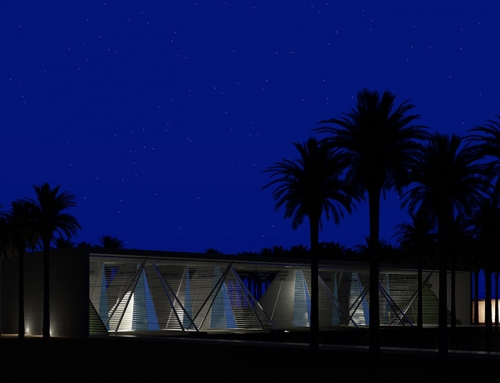
In response, BMDesign Studios has developed a resilient design strategy that not only mitigates water scarcity but also leverages aspects of climate change to the community’s advantage. Our concept of “concave roofs” introduces a safe-to-fail measure into the architectural system—a designed redundancy aimed at harvesting both rainwater and morning dew in hot, arid regions.
These concave roofs are particularly effective in the southern parts of Iran, where arid desert conditions meet the humid air of the Persian Gulf. At 60% efficiency, a single roof can collect up to 28 cubic meters of clean rainwater, in addition to capturing moisture from morning dew—transforming roofs from passive covers into active tools for water resilience.

Project Objectives:
Our goal was to explore whether the impacts of global warming—especially in regions hit the hardest—could be leveraged to benefit local communities. Specifically, we set out to design buildings in hot, semi-humid areas with minimal rainfall that could independently generate potable water from unconventional and renewable sources, primarily the atmosphere. This would reduce reliance on finite and already overstressed water reservoirs.
We also aimed to ensure that our solution would go beyond utility. It had to be aesthetically compelling and capable of creating a strong sense of place—one that resonates both at the scale of an individual building and within a broader urban context. This concept of architecture as a “living machine,” as Le Corbusier once described, is deeply rooted in Iran’s own architectural history. The iconic wind towers of Yazd are a prime example—structures that naturally cool the city’s buildings while also defining its unique urban character.
DISTINCTIVE CHARACTER
Project achievements:
-
Reduced Carbon Footprint Through Passive Cooling
The project employs a sustainable double-layered roof system to significantly reduce energy consumption for cooling. The upper “dish” layer shades the main roof beneath, preventing direct sunlight while allowing airflow between the layers—naturally ventilating the structure during hot summers. -
Raising Awareness on Water Scarcity and Climate Change
By visibly integrating rain and dew harvesting technologies into the architecture, the project highlights urgent global issues such as water shortage and global warming, sparking conversations and awareness through design. -
Nesting Bowls: Maximizing Dew Harvesting Efficiency
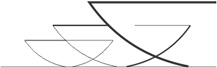
The concave, bowl-shaped roof design expands the dew collection surface by nearly six times compared to a conventional flat roof, greatly enhancing atmospheric water capture in dry, humid zones. -
Creating a Strong Urban Identity
The bowl-shaped roofs are designed to be modular and repeatable across rooftops, offering not only environmental benefits but also contributing to a coherent and memorable urban character—a visual identity rooted in both function and form. -
Rainwater Harvesting Potential
With an estimated annual rainfall of 193mm and an efficiency rate of 60% (based on Brad Lancaster’s dryland RWH models), one concave roof system measuring 923 m² can collect approximately 106 cubic meters of clean rainwater annually.Formula Used:
Rain Harvest (m³) = Catchment Area (m²) × Rainfall Depth (m) × Efficiency
923 × 0.193 × 0.60 ≈ 106 m³ Rain Harvest
-
Sunken Courtyard Architecture
Classrooms, offices, and libraries are organized around traditional sunken courtyards, inspired by desert cities such as Yazd and Nain. This approach traps cooler night air, reducing daytime cooling needs. Recessed openings further control solar gain, enhancing indoor thermal comfort. -
Integration of Date Palms
Strategically planted date palms provide seasonal shade to the concave roofs, support passive cooling, enhance spatial enclosure, and supply fruit—demonstrating the fusion of ecological performance with cultural context.


NESTING BOWLS


1. Concave Roofs / Rain-Harvesting Bowls
Rain Harvesting & Shading
Rain falls at speeds up to 10 meters per second. In heavy rains, droplets quickly combine to form flowing streams on surfaces. However, in light rainfall, these droplets often evaporate before they can accumulate. By employing steep, concave bowl-shaped roofs, we enhance the movement and collection of even the smallest droplets—guiding them to integrate and flow toward collection points.
These large outer bowls not only facilitate water harvesting but also provide essential shade for the roof below. This double-layered system allows for natural ventilation, cooling both the concave shell and the main roof, significantly reducing indoor temperatures in hot climates.
Dew Harvesting
Inspired by the Fog-Basking Beetle of the Namib Desert—an insect that collects water by condensing fog on its smooth back—our concave roof surfaces act in a similar way. The bowls’ smooth, cool surfaces encourage dew condensation, and their geometry directs the moisture down to be collected efficiently. This allows the building to passively harvest atmospheric moisture, even in arid conditions.
2. Sunken Courtyard Buildings
Passive Cooling & Radiant Night Cooling
Traditional desert architecture has long embraced courtyard buildings for their natural ability to retain cooler air. In our design, we take this a step further by employing sunken courtyards that sit below ground level, where the air is cooler and more stable. These enclosed spaces trap cold air at night, reducing ambient temperature for the entire building during the day.
Additionally, the open exposure of the roof to the cold night sky enables radiant cooling—further lowering the temperature of the concave roofs and accelerating dew formation during the early morning hours.
CONCAVE ROOF SYSTEM
CHALLENGES
Challenges to Realize the Design
Bringing this innovative design into reality involves addressing a series of environmental, technological, structural, economic, and social challenges:
ENVIRONMENTAL CHALLENGES
Shifting Climate Patterns
Global warming is altering traditional precipitation patterns. While overall rainfall is decreasing, relative humidity is increasing in regions where deserts meet water bodies—such as the southern coastal areas of Iran. This dual shift presents both a problem and an opportunity:
-
Less rainfall means we must develop efficient strategies to collect and store even the smallest amounts of water, as droplets that don’t flow are likely to evaporate quickly.
-
Higher humidity levels, however, offer greater potential for dew collection, especially during cold desert nights where radiant cooling supports condensation.
TECHNOLOGICAL CHALLENGES
Material Selection for Harvesting Dishes
One of the most critical aspects of this system is choosing the right material for the rain and dew-harvesting bowls. Several options were studied:
-
Metals: With their low specific heat, metals cool down rapidly and are highly effective for dew collection. However, they absorb and retain heat during the day, becoming inefficient for rainwater harvesting and contributing to indoor heat gain.
-
Coated Impermeable Fabrics (like those used in tensile structures): These were ultimately chosen as the optimal material. They offer:
-
A smooth surface ideal for guiding both rain and dew
-
Low thermal mass, allowing them to cool quickly at night to enhance dew formation
-
Resistance to water absorption and environmental degradation
-
STRUCTURAL CHALLENGES
Mounting the Concave Bowls
Supporting the large concave dishes above the main roof while maintaining airflow and minimizing structural load is a key design challenge. These elements must:
-
Be lightweight yet durable
-
Withstand wind loads
-
Allow for easy maintenance
-
Integrate seamlessly with the architectural composition
This requires a custom-engineered support system, likely involving tensile cable structures or lightweight frame assemblies.
ECONOMIC & SOCIAL CHALLENGES
High Initial Costs
Innovative sustainable technologies often come with a higher upfront cost, which can deter potential clients or stakeholders, particularly in areas with budget constraints.
Public Perception & Awareness
Despite the proven global success of rain and dew harvesting, many remain skeptical about its effectiveness or necessity. This creates an additional barrier, requiring education, advocacy, and demonstration of the system’s real-world performance.
PROJECT INFO:
ARCHITECTURE FIRM: BMDESIGN STUDIOS, BABAK MOSTOFI SADRI
OFFICE WEBSITE: WWW.BMDESIGNSTUDIOS.COM
COMPLETION YEAR: IDEA
BUILT AREA: 550 SQUARE METERS
PROJECT LOCATION: SOUTH OF IRAN
TYPE: PUBLIC SCHOOL
LEAD DESIGNER: BABAK MOSTOFI SADRI
DESIGN TEAM: DENA BAKHTIARI, NAZANIN ESFAHANIAN, NEGAR NAGHIBSADAT
MODEL: DENA BAKHTIARI
STRUCTURAL ENGINEER: SINA ROSTAMI
WORLDWIDE PUBLICATION
TEXTBOOKSOXFORD UNIVERSITY PRESS
Sustainable Solutions
Problem Solving for Current and
Future Generations
BY Richard A. Niesenbaum